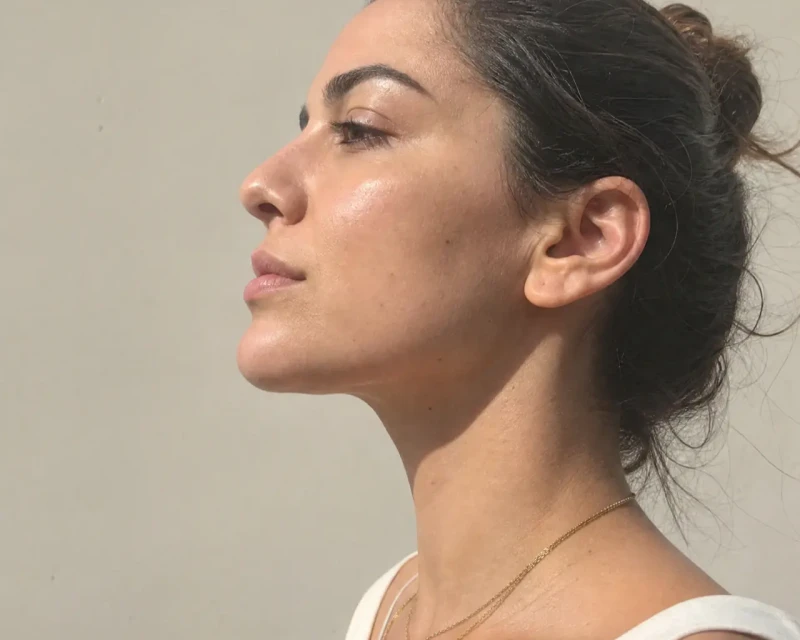

What Is Masseter Botox?
The masseter is a strong muscle that runs from in front of the ear to the angle of the lower jaw and is used for chewing. In people who clench or grind their teeth (bruxism) during the day or at night, this muscle works excessively and may thicken over time. As a result, the jaw angles may become more prominent, the lower face may look squarer, and pain in the jaw and temple area or a feeling of tiredness in the morning may occur.
Masseter Botox, also called jaw Botox or teeth-clenching Botox, is a botulinum toxin injection into this muscle. The muscle’s strength is temporarily reduced and the intensity of clenching eases. Because the muscle works less for a period, its volume may also decrease and the jawline may take on a softer appearance.
Who Is It Suitable For?
- People who clench or grind their teeth during sleep or during the day
- Those who feel jaw fatigue in the morning or pain around the temples or the jaw joint
- Those whose jaw angles are prominent because of muscle volume, giving the lower face a squarer look
- People whose bruxism has been identified by a dentist and who are looking for additional support alongside a night guard
If there are complaints such as locking of the jaw joint, clicking sounds or limited mouth opening, an evaluation by a dentist or an oral and maxillofacial surgeon is recommended first. Masseter Botox does not replace treatment in these cases, but it may be a supportive option.
How Is the Treatment Performed?
- At the consultation you are asked to clench your teeth; the thickness and borders of the muscle and any difference between the two sides are assessed by touch.
- When and in what situations your clenching increases, your sleep pattern and your stress level are discussed.
- Injection points are marked in the lower and middle parts of the muscle; care is taken not to go outside the safe area.
- Injections are given at several points on each side. The procedure usually takes 10–20 minutes.
- A follow-up visit takes place after about two weeks; the dose and symmetry are reviewed.
What Should You Keep in Mind Afterward?
- It is recommended that you do not lie down, massage or rub the area during the first 4 hours.
- It is advisable to avoid chewing gum and very hard foods on the first day.
- Avoid heavy exercise, saunas and steam baths for the first 24 hours.
- In the first weeks you may feel slight fatigue when chewing hard foods; this is expected and temporary.
- If you use a night guard, continue to use it as your dentist recommends.
Possible Side Effects and Who Should Not Have It
Mild tenderness, redness and small bruises may occur at the injection site. A temporary feeling of weakness when chewing is common and fades over time. Rarely, if the product affects the nearby smile muscles, temporary asymmetry of the smile may occur, and, uncommonly, a bulge in part of the muscle may become noticeable during chewing. In people whose skin support is clearly reduced, laxity in the lower face may become more visible as the muscle volume decreases; for this reason, the skin structure is also assessed separately at the consultation.
Treatment is not performed during pregnancy and breastfeeding, if there is an active infection in the area, in neuromuscular conditions, or in the case of an allergy to botulinum toxin.
Dr. Fulya Koç’s Approach
On social media, masseter Botox is often described as a face-slimming method. For Dr. Fulya Koç, the goal is not to fit the face to a trend, but to provide a relaxed look in harmony with your own facial structure and a more comfortable jaw. For this reason, doses that would slim the jawline excessively are avoided.
Teeth clenching is often related to stress, sleep quality and tension during the day. These factors are also discussed at the consultation, and, if needed, care is coordinated with your dentist. With regular treatment the muscle may gain less strength over time, so the dose and frequency are reassessed at later sessions.
Fulya Koç
Frequently asked questions
If the prominence at the jaw angles comes from muscle volume, the lower face may look softer and slimmer as the muscle shrinks. This change is usually noticed within 4–8 weeks. If the prominence comes from bone structure or fat tissue, the effect is limited.
The effect usually lasts 4–6 months. Muscle strength, the intensity of clenching and the person’s metabolism all influence the duration. In some people the intervals may lengthen with regular treatment.
Speech is not affected. In the first weeks you may feel tired more quickly when chewing hard foods; this feeling eases as the muscle adapts. Your ability to eat in daily life is preserved.
No, the two methods complement each other. A night guard protects the teeth from wear, while Botox reduces the clenching strength of the muscle. It is recommended to keep using your guard as your dentist advises.
The information on this page is general. Whether the treatment suits you, its possible risks and the results you can expect are assessed individually at your consultation. Results vary from person to person. Image is illustrative.